
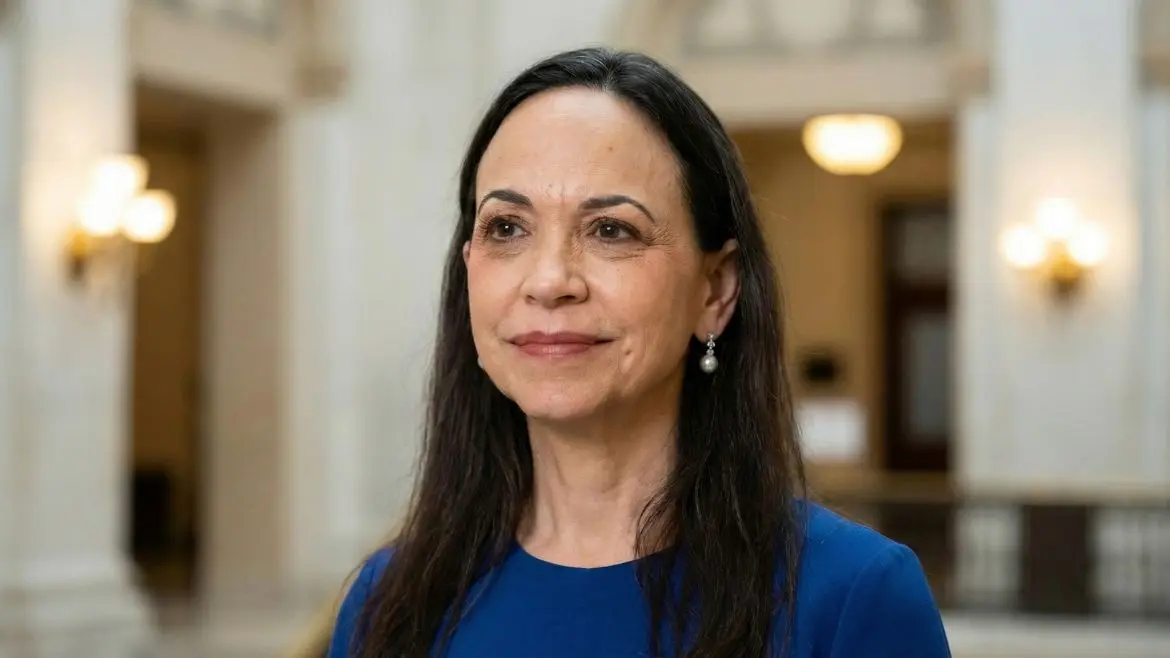
In the opening days of January 2026, the geopolitical landscape of the Americas shifted fundamentally. Maria Corina Machado, the indomitable opposition leader and 2025 Nobel Peace Prize laureate, stands at the center of a historic transition following the dramatic capture and ouster of Nicolas Maduro. As the “Iron Lady” of Venezuela calls for calm and constitutional order, the world watches to see if her vision of a free, democratic nation can finally be realized. This article provides an in-depth analysis of Maria Corina Machado, the pivotal events of 2026, and the road ahead for a country reclaiming its freedom.
Table of Contents
- Introduction
- Who is Maria Corina Machado?
- The Historic 2026 Turning Point
- The Letter That Changed Everything
- International Reactions: Trump and Macron
- Navigating the Venezuela Political Transition
- Why Machado Matters to the United States
- The Road Ahead: Rebuilding a Nation
- Conclusion
- Frequently Asked Questions (FAQs)
Introduction
History is rarely written in a single day, but the first weekend of January 2026 will forever mark a definitive chapter for Venezuela. After more than a decade of relentless struggle against an authoritarian regime, Maria Corina Machado has emerged as the guiding light of a nation in rapid transition. The news of Maduro ousted—captured in a high-stakes operation involving U.S. forces—sent shockwaves through the global community, leaving a power vacuum that only a leader of Machado’s caliber could navigate.
For years, Maria Corina Machado has been the face of resistance, enduring persecution, bans from public office, and threats to her life. Yet, she refused to flee, staying on the ground to mobilize millions and unite a fractured opposition. Now, as the dust settles on the Maduro capture news, all eyes are on her next move. She is not just a politician; to many, she is the “liberator” of the 21st century. This article explores how Maria Corina Machado orchestrated the political groundwork for this moment, the significance of her recent communications to the nation, and what her leadership means for the stability of the Western Hemisphere.
Who is Maria Corina Machado?
To understand the magnitude of the current moment, one must understand the resilience of the woman at its helm. Maria Corina Machado was born into a prominent family in Caracas, but she chose a path of immense personal risk over comfort. An industrial engineer by training, she entered the political arena with a singular vision: to restore Venezuela’s democratic institutions and free market economy.
The Rise of the “Iron Lady”
Maria Corina Machado first gained international prominence as the founder of the civil organization Súmate, fighting for electoral transparency. Her style has always been direct and uncompromising. She famously confronted Hugo Chávez in 2012, telling him to his face that “expropriation is theft,” a moment that cemented her reputation as the “Iron Lady.”
While the regime attempted to silence her by stripping her of her parliamentary seat and banning her from traveling, Maria Corina Machado only grew stronger. Her popularity surged in the 2023 primaries, where she won a landslide victory to become the opposition’s candidate, despite being barred from the ballot. By 2025, her tireless advocacy earned her the Nobel Peace Prize, elevating her status from a national opposition leader to a global icon of democracy.
The Historic 2026 Turning Point
The events of January 3, 2026, were the culmination of years of diplomatic pressure and internal resistance. The announcement that Nicolas Maduro had been captured and removed from power changed the calculus of Latin American politics overnight. While the military operation was the catalyst, the political legitimacy of the new era rests entirely on the shoulders of Maria Corina Machado and her coalition.
Maria Corina Machado had prepared for this scenario. For years, she built a network of “comanditos” (small citizen committees) across Venezuela to ensure that when the regime fell, there would be a structure to maintain order. The Venezuela political transition is not starting from scratch; it is activating a plan that Machado and her team have been refining for years. Her ability to remain in the country, often in hiding, allowed her to maintain a direct line to the people, ensuring that the Maduro ousted narrative was viewed not as a foreign imposition, but as a liberation long demanded by the Venezuelan electorate.
The Letter That Changed Everything
In moments of power vacuums, communication is critical to preventing chaos. On January 3, 2026, the Maria Corina Machado letter was released to the public, serving as a stabilizing force for a nervous nation. This document was more than a press release; it was a presidential-level address in all but title.
In the letter, Maria Corina Machado declared, “The time for freedom has come!” She urged Venezuelans to remain calm and organized, emphasizing that the objective was justice, not revenge. Crucially, she called for the immediate recognition of Edmundo González Urrutia—the opposition candidate she backed in the 2024 elections—as the legitimate President of Venezuela.
By directing the public’s energy toward constitutional order, Maria Corina Machado prevented the widespread looting and violence that many analysts feared. The letter outlined a clear path:
- Release of Political Prisoners: An immediate demand to free those detained by the former regime.
- National Unity: A call for the armed forces to uphold the constitution and support the transition.
- Reconstruction: A pledge to “bring our children back home,” referring to the millions of migrants who fled the country.
The Maria Corina Machado letter will likely go down in history as the document that bridged the gap between dictatorship and democracy.
International Reactions: Trump and Macron
The fall of the regime in Caracas drew immediate and varied reactions from global powers, underscoring the geopolitical weight of Maria Corina Machado.
The View from Washington
In the United States, the administration was quick to claim victory. The Trump Venezuela policy had long favored “maximum pressure,” and the capture of Maduro was presented as the ultimate validation of that strategy. President Trump stated that the U.S. would oversee the initial phase of stability, but acknowledged the pivotal role of local leadership. For Washington, Maria Corina Machado represents the ideal partner: a pro-market, pro-democracy leader who can stabilize the region.
Europe’s Stance
Across the Atlantic, French President Emmanuel Macron weighed in with a mix of relief and caution. The Macron Venezuela statement celebrated the end of the dictatorship but emphasized the need for a “swift and constitutional transition.” Macron, along with other European leaders, has long recognized the struggle of the Venezuelan opposition. Their support for Maria Corina Machado provides her with the international legitimacy needed to unlock frozen assets and secure reconstruction aid.
Both leaders, despite their differing political styles, recognize that Maria Corina Machado is the indispensable figure in this equation. Without her endorsement, any transition would lack credibility with the Venezuelan people.
Navigating the Venezuela Political Transition
With the dictator gone, the hard work begins. The Venezuela political transition is fraught with danger, from potential insurgencies by regime loyalists to the sheer scale of economic collapse. Maria Corina Machado has positioned herself as the guarantor of this process.
She has championed a “Grand National Alliance,” bringing together diverse political parties, unions, and civil society groups. Maria Corina Machado understands that a transition cannot be a revenge tour; it must be a rebuilding effort. Her rhetoric has shifted from the fiery defiance of the opposition to the measured tone of a stateswoman.
Key Priorities for the Transition
- Humanitarian Corridor: Maria Corina Machado has already reached out to international agencies to flood the country with food and medicine.
- Economic Stabilization: She plans to privatize the oil industry and adopt sound monetary policies to curb inflation.
- Judicial Reform: Establishing independent courts to handle the prosecution of former regime officials, ensuring due process rather than summary justice.
The Venezuela opposition news cycle is moving fast, but Machado’s steady hand is keeping the focus on institutional recovery rather than political infighting.
Why Machado Matters to the United States
Why should the average American care about Maria Corina Machado? The answer lies in the deep interconnectedness of the Western Hemisphere.
First, there is the migration crisis. The collapse of Venezuela under Maduro displaced nearly 8 million people, many of whom sought refuge at the U.S. southern border. A stable Venezuela, led by Maria Corina Machado, addresses the root cause of this migration. If Venezuelans believe in a future at home, the flow of migrants will reverse.
Second, energy security is paramount. Venezuela sits on the world’s largest proven oil reserves. Under the previous regime, these resources were mismanaged and often promised to U.S. adversaries. Maria Corina Machado advocates for a free-market energy sector that welcomes Western investment, potentially lowering global oil prices and enhancing U.S. energy security.
Finally, Maria Corina Machado represents a victory for democratic values in a region that has recently drifted toward authoritarianism. Her success is a powerful signal that resilience and democratic resistance can prevail.
The Road Ahead: Rebuilding a Nation
The coming months will test Maria Corina Machado like never before. The euphoria of the Maduro capture news will eventually fade, replaced by the stark reality of a bankrupt nation.
Maria Corina Machado has tasked her team with implementing “Plan Land of Grace,” a comprehensive strategy to revitalize the economy. This plan involves securing loans from the IMF and World Bank, restoring the rule of law, and inviting the Venezuelan diaspora to return with their skills and capital.
She faces the challenge of managing a military that was loyal to the former regime for decades. However, Maria Corina Machado has offered amnesty to low-ranking officers who lay down their arms and support the constitution, a strategic move to prevent civil conflict.
Her vision is ambitious: she sees Venezuela not as a broken nation, but as the future “energy hub of the Americas.” As she navigates the treacherous waters of post-dictatorship politics, the world is rooting for her. The rebuilding of a nation is a monumental task, but if anyone is up for the challenge, it is the Nobel laureate who never gave up.
Conclusion
The events of January 2026 have etched the name Maria Corina Machado into the history books alongside the great liberators of Latin America. She stood firm against a tyranny that seemed invincible and helped usher in a new dawn for her people.
While the headlines may focus on the military aspects of Maduro ousted, the enduring story is the civic resilience led by Maria Corina Machado. She kept the flame of hope alive when the world had looked away. Now, as that flame kindles a new day for Venezuela, her leadership is more critical than ever.
As Venezuela steps into the light, guided by Maria Corina Machado, the United States and the global community stand ready to support a free and prosperous partner. The road is long, and the challenges are immense, but for the first time in decades, the destination—freedom—is in sight.
Frequently Asked Questions (FAQs)
Q: Who is Maria Corina Machado? A: Maria Corina Machado is a Venezuelan industrial engineer and politician who serves as the leader of the democratic opposition. Known as the “Iron Lady” for her defiance against the socialist regime, she was awarded the Nobel Peace Prize in 2025.
Q: What happened in Venezuela in January 2026? A: In early January 2026, a U.S. military operation resulted in the capture of Nicolas Maduro, effectively ending his regime. This event triggered a major Venezuela political transition spearheaded by Maria Corina Machado and her coalition.
Q: What did the Maria Corina Machado letter say? A: The Maria Corina Machado letter, released on January 3, 2026, declared the “hour of freedom” had arrived. It called for calm, the release of political prisoners, and the installation of Edmundo González Urrutia as the legitimate president.
Q: Is Nicolas Maduro still in power? A: No. Following the Maduro capture news, reports confirmed he is in U.S. custody, facing charges related to narco-terrorism, paving the way for a new government.
Q: Does the U.S. support Maria Corina Machado? A: Yes, the U.S. government views Maria Corina Machado as a key democratic ally. Her free-market policies and commitment to democracy align closely with U.S. interests in the region.
Q: Can Maria Corina Machado run for president? A: While previously banned by the Maduro regime, the fall of the dictatorship removes those arbitrary restrictions. However, she currently advocates for Edmundo González Urrutia to assume the presidency based on the 2024 election results.
Q: What is the Trump Venezuela policy in 2026? A: The policy has been characterized by aggressive intervention, culminating in the operation to capture Maduro. The administration has pledged to support the transition while temporarily overseeing stability operations.
Visit Vic Waves for the latest trending USA news, updates, and insights you may have missed today, and more stories.