

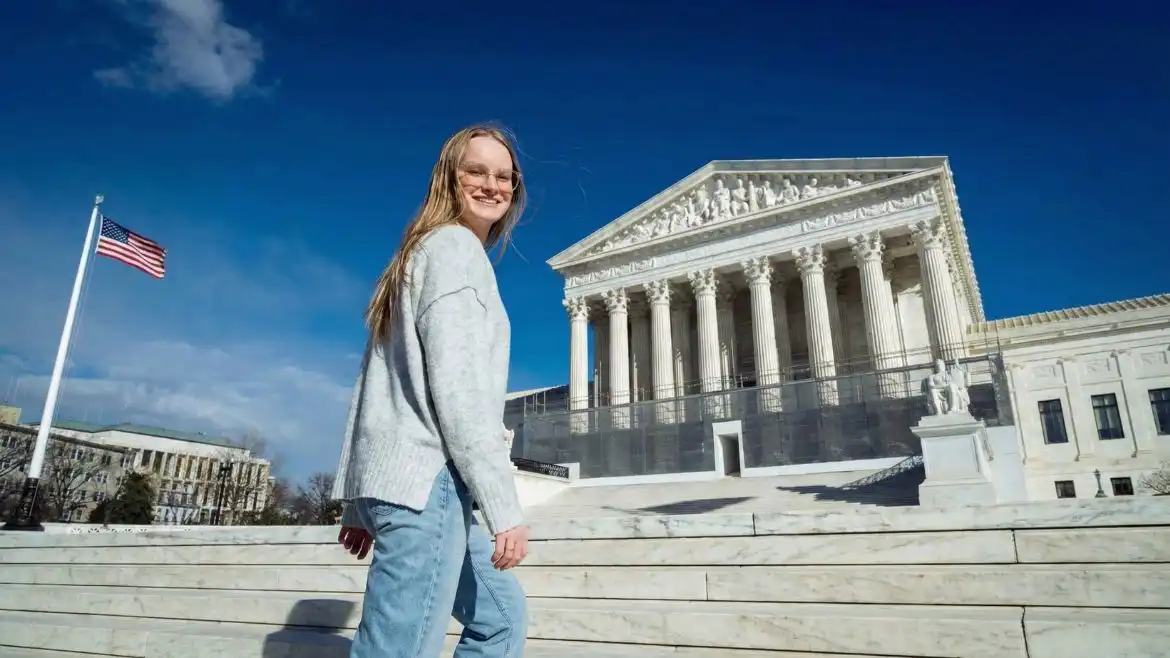
On January 13, 2026, the eyes of the nation turned to the U.S. Supreme Court for one of the most consequential civil rights hearings of the decade. At the heart of the proceedings was Kathleen Hartnett, the seasoned Cooley LLP partner and former White House official representing a teenage girl from West Virginia. This article explores Kathleen Hartnett‘s role in the landmark case West Virginia v. B.P.J., her distinguished legal background, and the potential impact of these arguments on LGBTQ+ rights across the USA.
Table of Contents
- Introduction
- The Case: West Virginia v. B.P.J.
- Inside the Courtroom: Oral Arguments January 13 2026
- Who Is Kathleen Hartnett?
- A Career Defined by Civil Rights and Strategy
- The Cooley LLP Connection: Big Law for Public Good
- Why This Case Matters for the Future
- Conclusion
- Frequently Asked Questions (FAQs)
Introduction
The air outside the Supreme Court was freezing on the morning of January 13, 2026, but the debate inside was scorching hot. As justices convened to hear oral arguments on whether states can ban transgender students from school sports, one name appeared repeatedly on the legal briefs and in the analysis of court watchers: Kathleen Hartnett.
Serving as Counsel of Record for the respondent in West Virginia v. B.P.J., Kathleen Hartnett has become a pivotal figure in the fight for transgender equality. The case centers on Becky Pepper-Jackson (B.P.J.), a teenage track athlete who has been fighting for years simply to run alongside her friends. For Kathleen Hartnett, this wasn’t just another day at the office; it was the culmination of years of litigation aimed at protecting vulnerable youth from discrimination. As the Supreme Court trans athletes debate reaches its apex, understanding the lawyer behind the defense provides crucial insight into how this historic battle is being waged.
The Case: West Virginia v. B.P.J.
To understand the weight on Kathleen Hartnett‘s shoulders, one must understand the stakes of the case. In 2021, West Virginia passed H.B. 3293, a law that categorically barred transgender girls from participating on female sports teams. The law was challenged by B.P.J., who was then just a middle schooler.
Kathleen Hartnett, working alongside the ACLU and Lambda Legal, helped secure a crucial victory in the Fourth Circuit Court of Appeals, which ruled that the ban violated Title IX and the Equal Protection Clause. West Virginia appealed to the Supreme Court, setting the stage for the showdown on Oral arguments January 13 2026.
The central argument presented by Kathleen Hartnett and her team is that the West Virginia transgender ban targets a tiny, marginalized group not to ensure fairness, but to exclude them from public life. By focusing on the specific facts—that B.P.J. has taken puberty blockers and has no physiological advantage over her peers—Kathleen Hartnett has meticulously dismantled the state’s broad claims about competitive fairness.
Inside the Courtroom: Oral Arguments January 13 2026
During the Oral arguments January 13 2026, the atmosphere was tense. The justices grilled both sides on the definitions of sex under Title IX and the implications of the Equal Protection Clause. Kathleen Hartnett‘s legal strategy has always been to humanize the abstract. While the state argued about hypothetical advantages and biological essentialism, Kathleen Hartnett‘s filings have consistently pointed back to the reality of her client: a girl who just wants to run.
Observers noted that the legal team, spearheaded by Kathleen Hartnett, faced tough questioning from the conservative wing of the bench. They were pressed on where the line should be drawn between biological sex and gender identity in competitive environments. However, the defense held firm on the precedent that “sex” in federal law is broad enough to protect transgender individuals from discrimination, a principle Kathleen Hartnett has defended throughout her career.
The performance of the defense team highlighted why Kathleen Hartnett is considered a top-tier LGBTQ rights attorney. The ability to pivot from complex constitutional theory to the simple, emotional reality of a teenager being singled out by her own government is a hallmark of her advocacy style.
Who Is Kathleen Hartnett?
For those outside the Beltway, the name Kathleen Hartnett might be new, but in legal circles, she is a heavyweight. Currently a partner at the global law firm Cooley LLP, she is part of the Commercial Litigation and Appellate practice groups. But her resume reads like a checklist for legal superstardom.
Kathleen Hartnett graduated magna cum laude from Harvard Law School, where she was treasurer of the Harvard Law Review. This academic excellence opened doors to the most prestigious clerkships in the country. She clerked for Judge Merrick Garland on the D.C. Circuit and later for Justice John Paul Stevens on the U.S. Supreme Court.
This deep experience with the inner workings of the judiciary gives Kathleen Hartnett a unique advantage. She knows how justices think, what arguments resonate in conference, and how to craft a brief that survives the scrutiny of the highest court in the land. When Kathleen Hartnett walks into a courtroom, she brings with her the institutional knowledge of a former insider.
A Career Defined by Civil Rights and Strategy
Before entering private practice, Kathleen Hartnett served in the Obama White House. As Special Assistant to the President and Associate Counsel to the President, she worked on high-stakes issues ranging from immigration to healthcare. This government service honed her ability to navigate the intersection of law, policy, and public opinion.
Her transition to becoming a prominent Cooley LLP lawyer did not dampen her commitment to public interest. Kathleen Hartnett has maintained a robust pro bono practice, often taking on cases that others might find too politically charged. Her involvement in West Virginia v. B.P.J. is consistent with a career dedicated to defending constitutional norms.
Whether she is representing major tech companies in commercial disputes or a teenage girl in West Virginia, Kathleen Hartnett applies the same rigorous standard. She is known for her calm demeanor and razor-sharp intellect—traits that are indispensable when arguing before a polarized Supreme Court.
The Cooley LLP Connection: Big Law for Public Good
It is worth noting the institutional backing Kathleen Hartnett brings to this fight. Cooley LLP is a powerhouse firm known for its work with technology giants and startups. However, under leaders like Kathleen Hartnett, the firm has also become a major player in social justice litigation.
By deploying the resources of a “Big Law” firm to support civil rights cases, Kathleen Hartnett ensures that marginalized clients have the same quality of representation as Fortune 500 companies. In the West Virginia case, this meant extensive expert testimony, exhaustive research, and a polish that matches the resources of the state attorneys general on the other side.
The strategy employed by Kathleen Hartnett leverages this corporate discipline. Her team’s briefs are noted for being empirically driven, dismantling the state’s pseudo-scientific claims about transgender athleticism with hard data and medical consensus. This is the Kathleen Hartnett signature: winning on the facts so the law has to follow.
Why This Case Matters for the Future
The arguments presented on January 13, 2026, will likely dictate the future of LGBTQ+ rights for a generation. If Kathleen Hartnett and her team prevail, it will cement the idea that transgender people are entitled to equal protection under the law in all aspects of public life, including sports.
A loss, however, could embolden states to pass even more restrictive measures. This is why the role of Kathleen Hartnett is so critical. She is arguably the last line of defense against a nationwide rollback of transgender rights. Her arguments regarding “heightened scrutiny”—the idea that laws targeting transgender people should be viewed with skepticism by courts—are central to the broader legal movement.
As the justices retreat to draft their opinions, the legal community is buzzing about the efficacy of the points raised by the respondents. Regardless of the outcome, Kathleen Hartnett has already shaped the conversation, ensuring that the dignity of her client remained the focal point of the proceedings.
Conclusion
On a cold day in January 2026, history was made in Washington, and Kathleen Hartnett was one of its primary authors. Her defense of B.P.J. against the West Virginia transgender ban is a testament to her skill, her passion, and her unwavering belief in equality.
From her days clerking for Justice Stevens to her current role as a premier Cooley LLP lawyer, Kathleen Hartnett has proven that the law is a powerful tool for change when wielded by the right hands. As the nation awaits the Supreme Court’s decision, one thing is certain: Kathleen Hartnett has left an indelible mark on the fight for civil rights in America. Her work ensures that no matter the verdict, the voice of the vulnerable was heard loud and clear in the halls of power.
Frequently Asked Questions (FAQs)
Who is Kathleen Hartnett? Kathleen Hartnett is a partner at the law firm Cooley LLP and a prominent attorney specializing in high-stakes litigation and appellate law. She is a former clerk for Supreme Court Justice John Paul Stevens.
What case did Kathleen Hartnett argue in 2026? Kathleen Hartnett served as Counsel of Record for the respondent in West Virginia v. B.P.J., a landmark Supreme Court case regarding the rights of transgender students to participate in school sports.
What happened during the oral arguments on January 13, 2026? During the Oral arguments January 13 2026, the Supreme Court heard the case of West Virginia v. B.P.J. along with a related case from Idaho. The arguments focused on whether state bans on transgender athletes violate Title IX and the Equal Protection Clause.
Is Kathleen Hartnett an LGBTQ rights attorney? Yes, while she works in commercial litigation, Kathleen Hartnett is widely recognized as a leading LGBTQ rights attorney due to her extensive pro bono work, including representing transgender youth in federal court.
What is the West Virginia transgender ban? The West Virginia transgender ban refers to H.B. 3293, a state law passed in 2021 that prohibits transgender girls and women from participating on female sports teams in public schools and colleges.
Did Kathleen Hartnett work in the White House? Yes, prior to joining Cooley LLP, Kathleen Hartnett served in the Obama administration as Special Assistant to the President and Associate Counsel to the President.
Visit Vic Waves for the latest trending USA news, updates, and insights you may have missed today, and more stories.