

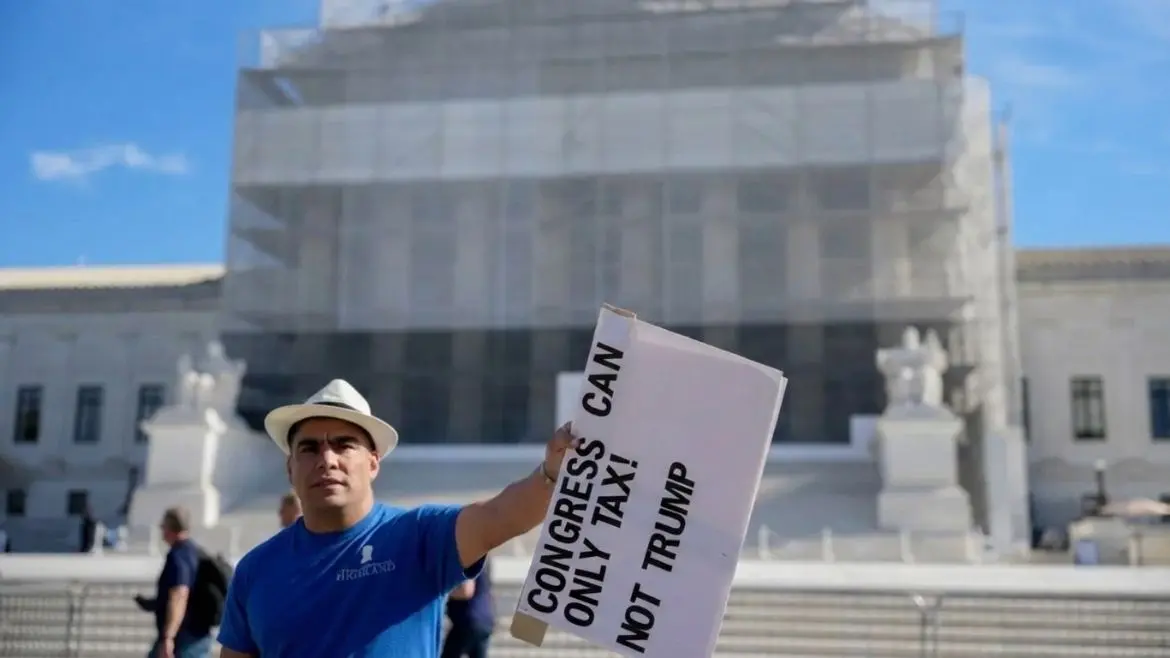
Supreme Court Tariff Ruling: The U.S. Supreme Court declined to issue a ruling on Wednesday regarding the legality of President Donald Trump’s sweeping tariffs, extending a period of high anxiety for Wall Street and international trade partners. The case, which challenges the President’s use of emergency powers to impose levies on Mexico, Canada, and China, remains undecided, leaving billions in potential tax refunds and the future of U.S. trade policy in limbo.
Table of Contents
- The Delay: Another Week of Waiting
- The Legal Battle: Presidential Power vs. Congressional Authority
- The Tariffs at Stake: Mexico, Canada, and China
- Market Reaction: Wall Street on Edge
- What Comes Next?
Supreme Court Tariff Ruling:
The Delay: Another Week of Waiting
For the second time in as many weeks, the U.S. Supreme Court released a list of opinions without addressing the blockbuster case challenging President Trump’s “reciprocal” tariffs. The silence from the high court on Wednesday, January 14, 2026, means businesses and investors must wait at least another week to learn whether the judiciary will curb the executive branch’s aggressive trade strategy.
Legal experts had widely anticipated a decision this week given the accelerated timeline of the case and its massive economic implications. The delay suggests deep divisions among the justices or the crafting of a complex, nuanced opinion that could redefine presidential emergency powers for decades to come.
The Legal Battle: Presidential Power vs. Congressional Authority
At the heart of the case is the International Emergency Economic Powers Act (IEEPA) of 1977. The Trump administration has invoked this law to impose tariffs by declaring national emergencies related to:
- Trade Deficits: Citing “unfair” trade imbalances as a threat to national security.
- Fentanyl Trafficking: Using the flow of illicit drugs as justification for economic sanctions on neighbors like Mexico.
Challengers, including a coalition of importers and business groups, argue that IEEPA was never intended to transfer Congress’s constitutional power to tax and regulate commerce to the President. During oral arguments in November 2025, several justices—including key conservatives—expressed skepticism about the administration’s broad interpretation of the statute.
The Tariffs at Stake: Mexico, Canada, and China
The ruling will determine the fate of a massive tariff regime that has reshaped North American and global supply chains:
- Mexico & Canada: A 25% tariff on most goods, with specific carve-outs for energy products from Canada (taxed at 10%).
- China: Continued heavy levies, with new layers added under the “reciprocal” framework.
- Global Reciprocal Tariffs: A baseline 10% tariff on imports from most other nations, with rates soaring up to 50% for countries deemed to have “non-reciprocal” trade barriers.
If the Court rules against the administration, the U.S. Treasury could theoretically be on the hook for hundreds of billions of dollars in refunds to importers—a scenario President Trump has warned would be a “terrible blow” to the U.S. fiscal position.
Market Reaction: Wall Street on Edge
Financial markets reacted negatively to the continued uncertainty. Stocks with heavy exposure to imports, such as Nike (NKE), Lululemon (LULU), and RH (RH), saw renewed selling pressure as traders priced in the risk of prolonged trade friction.
“The market hates uncertainty more than bad news,” said one senior strategist. “Until we know if these 25% levies are permanent law or unconstitutional overreach, capital spending plans are frozen.”
Bond markets also showed strain, as the potential loss of tariff revenue—which the administration has used to offset tax cuts—could widen the federal deficit.
What Comes Next?
The Supreme Court typically releases opinions on Tuesdays and Wednesdays. All eyes now turn to January 20 and 21, the next likely dates for a decision.
In the meantime, the political rhetoric is heating up. During a tour of a Ford factory in Michigan on Wednesday, President Trump dismissed the United States-Mexico-Canada Agreement (USMCA) as “irrelevant” in the face of his tariff strategy, signaling that regardless of the Court’s ruling, his administration intends to maintain a combative stance on trade.
Visit Vic Waves for the latest trending USA news, updates, and insights you may have missed today, and more stories.