
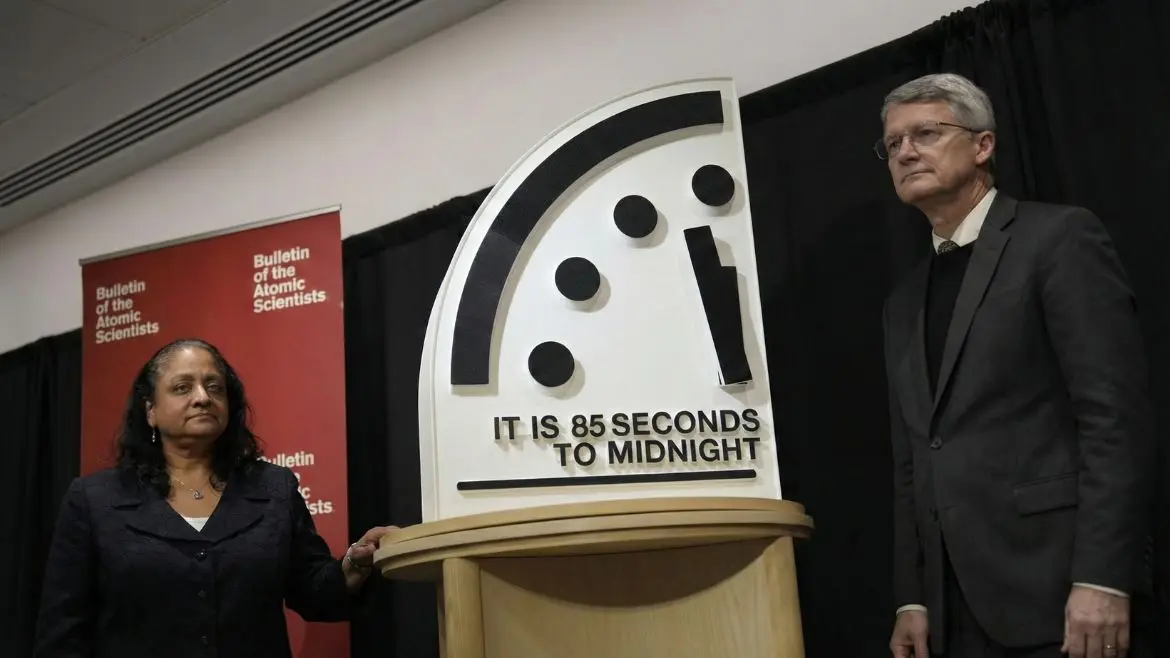
In January 2026, the Bulletin of the Atomic Scientists announced that the doomsday clock would remain set at 90 seconds to midnight, maintaining the closest proximity to global catastrophe in its history. This article explores the reasoning behind this decision, analyzing the trifecta of threats—nuclear threat, climate crisis, and AI risks—that keep the hands dangerously close to the symbolic end of the world. We delve into the history of the clock, the specific dangers cited by Rachel Bronson and the science board, and what this warning means for the future of humanity.
Table of Contents
- The 2026 Announcement: Still on the Brink
- What Is the Doomsday Clock?
- Why is the Doomsday Clock at 90 Seconds to Midnight?
- The Nuclear Threat: A World at War
- The Climate Crisis: Running Out of Time
- Artificial Intelligence and Biological Risks
- Can We Turn Back the Clock?
- Conclusion
- Frequently Asked Questions (FAQs)
The 2026 Announcement: Still on the Brink
It is a metaphor that has haunted the modern world for nearly 80 years: a clock face where midnight represents the end of civilization. On January 27, 2026, the world held its breath as the Bulletin of the Atomic Scientists 2026 announcement was broadcast from Washington, D.C. The verdict? The doomsday clock remains frozen at 90 seconds to midnight.
While some might find comfort in the fact that the hands did not move forward, the reality is far more sobering. Being 90 seconds away from a global catastrophe is not a sign of stability; it is a desperate warning. Rachel Bronson, the president and CEO of the Bulletin, emphasized that keeping the clock at this time is not an indication that the world is safer. Instead, it highlights that the unstable nature of global affairs has become a terrifying “new normal.”
The Doomsday Clock update January 2026 reflects a world besieged by compounding crises. The decision to maintain this time was driven by the Science and Security Board, a group of experts who analyze specific threats to human existence. They determined that the risks of nuclear war, unchecked climate change, and disruptive technologies like Artificial Intelligence have not abated since the clock first moved to 90 seconds in 2023.
What Is the Doomsday Clock?
Before diving into the specific threats of 2026, it is helpful to understand the tool itself. The doomsday clock is not a literal timepiece that counts down the minutes of the day. It is a symbolic design created in 1947 by scientists who had participated in the Manhattan Project—the very people who built the first atomic bomb.
Originally, the clock was intended to measure the nuclear threat. When it debuted, it was set at seven minutes to midnight. Over the decades, the Bulletin of the Atomic Scientists has adjusted the time based on geopolitical events.
- Furthest from Midnight: In 1991, at the end of the Cold War, the clock was set back to 17 minutes to midnight.
- Closest to Midnight: Since 2023, the clock has hovered at 90 seconds to midnight, the closest it has ever been.
The apocalypse clock has evolved. Today, it doesn’t just measure the risk of atomic warfare. It assesses all man-made threats that could destroy civilization, including the climate crisis and AI risks. It serves as a universal wake-up call, urging leaders and citizens to take action before time runs out.
Why is the Doomsday Clock at 90 Seconds to Midnight?
Many Americans are asking, “Why is the Doomsday Clock at 90 seconds to midnight?” The answer lies in the convergence of three major existential threats that are no longer separate issues but are deeply interconnected.
The 2026 Doomsday Clock setting reflects a lack of meaningful progress in resolving global conflicts and environmental degradation. The Board cited the ongoing war in Ukraine, tensions in the Middle East, and the rapid, unregulated advancement of generative AI as primary reasons.
When we ask, “How close is the world to doomsday?”, the answer is uncomfortably close. The 90-second mark is a historic low. It signals that the margin for error is razor-thin. A single miscalculation by a world leader, a rogue algorithm, or a natural tipping point could push humanity over the edge.
The Nuclear Threat: A World at War
The most traditional driver of the doomsday clock remains the nuclear threat. In the Doomsday Clock 2026 nuclear war risk assessment, the Bulletin pointed to several flashpoints that could escalate into atomic conflict.
The Russia-Ukraine Conflict
As the war in Ukraine drags on, the threat of tactical nuclear weapon usage remains a dark cloud over Europe. The suspension of key nuclear treaties has eroded the guardrails that once kept superpowers in check.
Modernization of Arsenals
It isn’t just about old wars; it is about new weapons. The United States, Russia, and China are all in the process of modernizing their nuclear arsenals. This three-way nuclear arms race creates a dangerous dynamic that the world has never seen before. The doomsday clock reflects the fear that as weapons become faster and harder to detect, the window for diplomacy closes.
The Middle East
The conflict involving Israel and Gaza continues to destabilize the region, drawing in other nuclear-capable or nuclear-aspirant nations. The Board noted that regional wars have a high potential to spiral out of control, increasing the doomsday clock urgency.
The Climate Crisis: Running Out of Time
While nuclear war is a sudden potential ending, the climate crisis is a slow-motion catastrophe that is already claiming lives. The connection between climate change and Doomsday Clock 2026 is undeniable.
2025 was the hottest year on record, a fact that weighed heavily on the scientists’ decision. Despite numerous international summits and pledges, global carbon emissions continue to rise. The physical effects are visible across the United States:
- More intense hurricanes hitting the coasts.
- Prolonged droughts in the West.
- Unprecedented heatwaves in the South.
The Bulletin of the Atomic Scientists warned that the world is failing to invest enough in renewable energy to meet the goals of the Paris Agreement. The doomsday clock remains close to midnight because the window to prevent the worst effects of climate change—such as uninhabitable zones and mass migration—is rapidly closing.
Artificial Intelligence and Biological Risks
In recent years, a new hand has effectively been added to the doomsday clock: the risk of disruptive technology. The Artificial Intelligence impact on Doomsday Clock decisions has grown significantly.
AI Risks
AI risks are not just about robots taking jobs; they are about control and truth. The 2026 statement highlighted the danger of AI-enabled disinformation. In an election year, deepfakes and algorithmic propaganda can undermine democracy, making it impossible for nations to solve problems like climate change or nuclear proliferation. Furthermore, the potential for AI to be used in cyber-warfare or to automate weapons systems adds a layer of unpredictability to global security.
Biological Threats
The Board also noted the risks of biological research. The ability to engineer pathogens is becoming more accessible. Without strict international oversight, accidental leaks or the intentional creation of bioweapons could cause a global catastrophe akin to a pandemic but with much higher lethality.
Can We Turn Back the Clock?
The news about the doomsday clock often feels paralyzing, but the Bulletin of the Atomic Scientists insists that the clock is not a prediction—it is a warning. It is possible to turn back the hands.
We have done it before. After the Cold War ended, the clock moved back significantly. To move the 2026 Doomsday Clock away from midnight, specific actions are needed:
- Nuclear Dialogue: The U.S., Russia, and China must resume serious dialogue about arms control and crisis stability.
- Climate Action: Nations must drastically cut fossil fuel reliance and invest in green transition technologies immediately.
- Tech Regulation: Governments need to implement robust safety standards for AI and biological research to prevent misuse.
Rachel Bronson stated that “We can turn back the clock, but we have to do it together.” Public awareness is the first step. When citizens understand the meaning of 90 seconds to midnight, they can pressure leaders to prioritize survival over political posturing.
Conclusion
The doomsday clock at 90 seconds to midnight is a stark reminder of the fragile state of our world in 2026. Whether it is the shadow of a nuclear threat, the rising tides of the climate crisis, or the unknown dangers of AI risks, the challenges we face are existential.
However, the clock is man-made, and so are the problems it measures. This means the solutions are also within our grasp. The Bulletin of the Atomic Scientists 2026 announcement serves not as a death knell, but as a call to action. We possess the diplomatic tools, the scientific knowledge, and the technological capability to secure a safer future. The only question remains: will we use them before the clock strikes midnight?
Frequently Asked Questions (FAQs)
1. What time is the Doomsday Clock set to in 2026? The 2026 Doomsday Clock is set to 90 seconds to midnight. This is the same time as it was set in 2023, 2024, and 2025.
2. Did the Doomsday Clock move forward in 2026? No, the clock did not move forward. It remained static at 90 seconds to midnight. However, the Bulletin of the Atomic Scientists emphasized that this should not be interpreted as a sign of safety, but rather a sign that the danger remains at a historic high.
3. What is the meaning of 90 seconds to midnight? The meaning of 90 seconds to midnight is that humanity is metaphorically 1.5 minutes away from a global catastrophe. It indicates that the threat level to human civilization is currently higher than it was during the height of the Cold War.
4. How does the climate crisis affect the Doomsday Clock? Climate change and Doomsday Clock 2026 are closely linked. The failure of nations to sufficiently reduce carbon emissions and the increasing frequency of extreme weather events are major factors that keep the clock’s hands close to midnight.
5. What are the AI risks mentioned in the update? The Artificial Intelligence impact on Doomsday Clock assessments centers on the potential for AI to accelerate disinformation, automate weapons systems, and be used in biological engineering without sufficient oversight or regulation.
Visit Vic Waves for the latest trending USA news, updates, and insights you may have missed today, and more stories.