

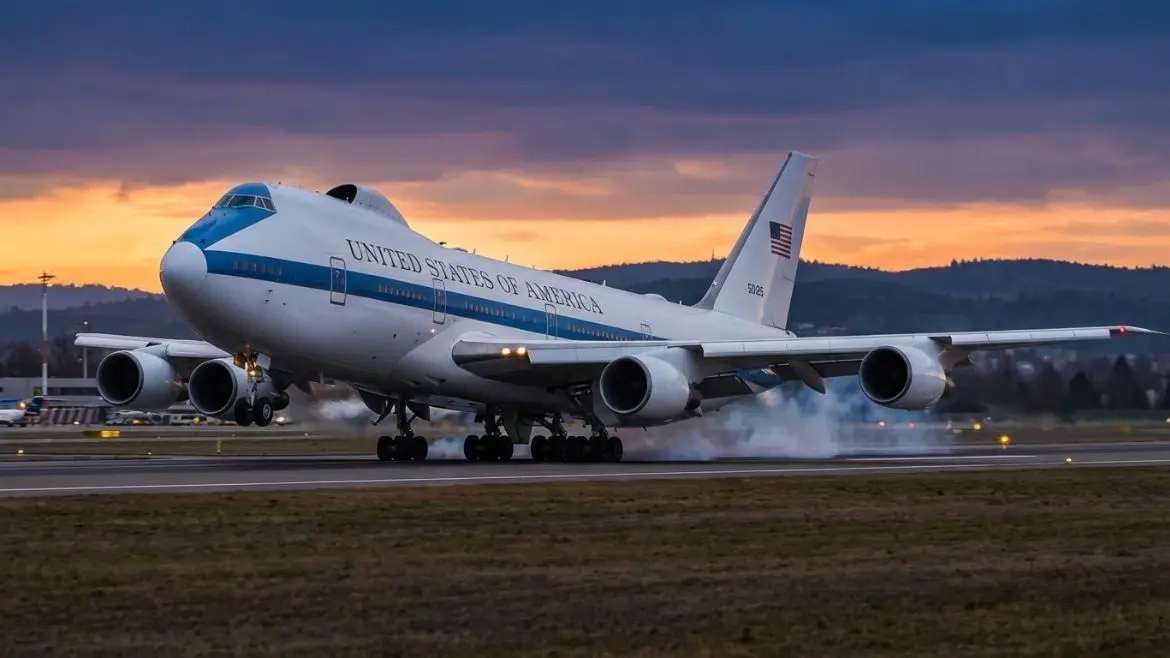
This article provides an in-depth look at the mysterious and powerful aircraft known as the doomsday plane. We explore its technical capabilities, its critical role in national security, and the recent buzz surrounding its movements across the country. From its ability to withstand nuclear blasts to its mobile command center features, learn why this sky-bound fortress is essential for the United States government.
Table of Contents
- Introduction
- What Exactly is the Doomsday Plane?
- The E-4B Nightwatch: A Technical Marvel
- Recent Movements: From LAX to Washington D.C.
- Inside the Flying Bunker: Layout and Crew
- Unmatched Capabilities: Why It Is Indestructible
- The Doomsday Plane vs. Air Force One
- The Strategic Importance in the Modern Era
- The Future of the Fleet
- Conclusion
- Frequently Asked Questions (FAQs)
Introduction
In the world of aviation and national defense, few machines capture the public’s imagination quite like the doomsday plane. It is a term that evokes images of high-stakes thrillers and Cold War tension. Yet, this aircraft is very real and serves a critical function for the United States. Whenever geopolitical tensions rise or major political transitions occur, eyes turn to the sky to track the movements of this modified Boeing 747.
The doomsday plane is designed to be the ultimate survival tool for the President, the Secretary of Defense, and the Joint Chiefs of Staff. In the event of a nuclear war or a catastrophic national emergency that wipes out ground-based command centers, this aircraft becomes the Pentagon in the sky. With recent sightings making headlines, curiosity about this airborne command post is at an all-time high. This article delves deep into the engineering, history, and purpose of the aircraft that ensures the U.S. government continues to function, even in the worst-case scenario.
What Exactly is the Doomsday Plane?
When people hear the term doomsday plane, they often wonder if it is a secret weapon. In reality, it is a command and control center. Officially known as the National Airborne Operations Center (NAOC), its primary mission is to keep the lines of communication open when everything else fails.
The United States Air Force maintains a fleet of four of these aircraft. At least one doomsday plane is on alert 24 hours a day, 7 days a week, ready to launch with a specialized crew at a moment’s notice. It is not just a mode of transport; it is a floating hub of strategy and authority. The logic is simple: if ground bases are destroyed, the leadership must take to the air to coordinate military assets, including the nuclear arsenal.
The E-4B Nightwatch: A Technical Marvel
The technical name for the doomsday plane is the E-4B Nightwatch. It is a highly modified version of the Boeing 747-200B. While it looks like a standard jumbo jet from the outside—aside from the distinctive hump and the lack of windows—the inside is a marvel of military engineering.
The E-4B Nightwatch entered service in the 1970s during the height of the Cold War. Its systems are designed to survive environments that would render modern electronics useless. The aircraft is shielded against electromagnetic pulses (EMP), which are bursts of energy released by nuclear explosions that can fry computer circuits. To achieve this, the plane relies on analog flight instruments alongside its advanced digital communications. This blend of old-school durability and high-tech connectivity makes the doomsday plane unique in the skies.
Recent Movements: From LAX to Washington D.C.
In early 2026, aviation trackers and news outlets reported significant activity regarding the fleet. A Doomsday plane LAX sighting sparked conversations across social media platforms. Seeing such a massive, militarized aircraft at a commercial hub like Los Angeles International Airport is rare and often signals specific logistical drills or high-level VIP movements.
Shortly after the West Coast appearance, reports surfaced that the doomsday plane moved to Washington. A Doomsday plane Washington DC arrival usually aligns with major state events or periods of transition. For instance, recent reports have linked these movements to the transition of power, referring to it as the Trump Doomsday plane in the context of the incoming administration ensuring continuity of government. These movements serve as a reminder that the machinery of national defense never sleeps. Whether it is sitting on the tarmac at Offutt Air Force Base in Nebraska or touching down in the nation’s capital, the aircraft is always positioned strategically.
Inside the Flying Bunker: Layout and Crew
What does life look like inside a doomsday plane? Unlike the luxury associated with Air Force One, the E-4B is strictly utilitarian. The interior is divided into three decks and holds a crew of up to 112 people. This is the largest crew of any US Air Force aircraft.
The Command Deck
The main deck is divided into six functional areas:
- Command Work Area: This is where the decision-makers sit. It functions like a war room, with screens displaying real-time data from around the globe.
- Conference Room: A soundproof room where the President or Secretary of Defense can hold secure meetings.
- Briefing Room: Used for updating the staff on the unfolding crisis.
- Operations Team Area: Packed with specialists who manage the logistics of the mission.
- Communications Area: The nerve center of the plane, housing 42 distinct communications systems.
- Rest Area: Bunks and seats for the crew, who may have to stay airborne for days.
The environment is loud and cramped compared to commercial travel. The focus is entirely on functionality. The doomsday plane is equipped to feed and rest its massive crew, ensuring they can operate at peak efficiency even during a prolonged crisis.
Unmatched Capabilities: Why It Is Indestructible
The defining feature of the doomsday plane is its survivability. The engineering goes far beyond standard safety measures.
Electromagnetic Pulse (EMP) Protection
As mentioned, the hull and systems are hardened against EMPs. In a nuclear conflict, the ionization of the atmosphere could disable the electronics of standard planes, causing them to fall from the sky. The doomsday plane is built to keep flying through these conditions.
Aerial Refueling
One of the most impressive capabilities is its endurance. With aerial refueling, the E-4B can theoretically stay airborne for a week, limited only by the endurance of the crew and the supply of engine oil. This allows the command center to remain safe in the air while the situation on the ground stabilizes.
Advanced Communications
The distinctive bubble on top of the fuselage houses a super-high-frequency satellite antenna. The plane also trails a five-mile-long wire antenna for Very Low Frequency (VLF) communications. This allows the doomsday plane to communicate with submerged nuclear submarines, ensuring that the US Air Force nuclear command aircraft maintains contact with all legs of the nuclear triad (land, air, and sea).
The Doomsday Plane vs. Air Force One
Many people confuse the doomsday plane with Air Force One. While both are modified Boeing 747s and both transport the President, their missions are vastly different.
- Air Force One (VC-25): Designed for public relations, diplomacy, and comfort. It has a stately office, a bedroom, and space for the press. It projects American power through presence.
- Doomsday Plane (E-4B): Designed for war. It has no press space and very little comfort. It projects American power through capability and survival.
If the President is on board the E-4B, it technically uses the call sign “Air Force One,” but its function remains that of a National Airborne Operations Center. Usually, the doomsday plane shadows Air Force One during overseas trips. If the President’s primary plane malfunctions or if a crisis erupts that requires advanced military coordination, the President can transfer to the E-4B.
The Strategic Importance in the Modern Era
In the post-Cold War era, some argued that the doomsday plane was a relic of the past. However, the geopolitical landscape of the 2020s has proven its continued relevance. With rising tensions among global superpowers and the modernization of nuclear arsenals worldwide, the need for a survivable command post is as high as ever.
The doomsday plane serves as a deterrent. It signals to adversaries that decapitating the U.S. government is impossible. Even if Washington D.C. were compromised, the authority to launch a counter-strike would remain intact in the skies. This guarantee of “Mutually Assured Destruction” is a grim but necessary pillar of global peace.
Furthermore, the aircraft plays a role in disaster response. During natural disasters like hurricanes or earthquakes, the E-4B can serve as a communication relay and command hub when ground infrastructure is destroyed.
The Future of the Fleet
The current fleet of E-4Bs has been in service for over four decades. Like any aging machine, maintenance is becoming difficult and costly. The Air Force has acknowledged the need to replace the doomsday plane.
The replacement program is known as the Survivable Airborne Operations Center (SAOC). The military is working with aerospace contractors to design a modern airframe that incorporates 21st-century technology while maintaining the analog hardiness required for nuclear survival. Until the new fleet is operational—likely in the 2030s—the current E-4Bs will continue to undergo upgrades to keep them airworthy. The sight of a doomsday plane will remain a fixture in American skies for years to come.
Conclusion
The doomsday plane is more than just a terrifying nickname; it is a marvel of engineering and a cornerstone of American defense strategy. From the specialized E-4B Nightwatch systems to the dedicated crew that keeps it flying, every aspect of this aircraft is designed with one goal: continuity.
Recent events, such as the Doomsday plane LAX sighting and its relocation to the capital, serve as visible reminders of the invisible shield that protects the nation. While we all hope the doomsday plane never has to fulfill its primary purpose, its existence provides a layer of security in an unpredictable world. It stands as a silent sentinel, a flying fortress ready to weather the ultimate storm.
Frequently Asked Questions (FAQs)
How many doomsday planes does the US have? The United States Air Force operates a fleet of four E-4B Nightwatch aircraft. At least one is always on high alert.
Can the doomsday plane survive a nuclear blast? While no aircraft can survive a direct hit from a nuclear weapon, the doomsday plane is hardened against the thermal and electromagnetic effects of a nuclear explosion, allowing it to fly in the vicinity of a blast.
Where is the doomsday plane usually stationed? The primary base for the E-4B fleet is Offutt Air Force Base in Nebraska. However, they frequently travel to bases worldwide to support the President and Secretary of Defense.
Why was the doomsday plane in Los Angeles recently? Specific mission details are rarely classified, but the aircraft often travels for training missions, maintenance, or to shadow the President during travel to the West Coast.
Is there a replacement for the doomsday plane? Yes, the US Air Force is currently developing the Survivable Airborne Operations Center (SAOC) to eventually replace the aging E-4B fleet.
Visit Vic Waves for the latest trending USA news, updates, and insights you may have missed today, and more stories.