
The 2026 season has been a landmark year for the Rebels. Ole Miss football has once again captured the national spotlight, marching all the way to the Mercedes-Benz Superdome for a high-stakes College Football Playoff Quarterfinal. This article dives deep into the current state of the program, analyzing the intense Sugar Bowl matchup against Georgia, the key playmakers like Trinidad Chambliss, and the strategic vision of Head Coach Pete Golding.
Table of Contents
- Introduction
- The Road to the 2026 Sugar Bowl
- Breaking Down Georgia vs Ole Miss
- Trinidad Chambliss: Leading the Rebels Offense
- The Defensive Mindset of Pete Golding
- Turning Points: The Daylen Everette Fumble Return
- Facing the Bulldog Offense: Gunner Stockton
- The Enduring Culture of the Rebels
- Conclusion
- Frequently Asked Questions (FAQs)
Introduction
In the landscape of American sports, few things rival the passion and pageantry of Ole Miss football. From the legendary tailgates at The Grove to the electric atmosphere inside Vaught-Hemingway Stadium, the Rebels represent the heart of the SEC. The 2025-2026 season has been particularly special, serving as a testament to the program’s resilience and ability to compete with the nation’s elite.
Fans across the country tuned in on New Year’s Day to witness the Rebels take the field for the College Football Playoff Quarterfinal. It wasn’t just another bowl game; it was a validation of the hard work put in by the coaching staff and players. Ole Miss football has a storied history, but the modern era is defined by speed, high-scoring offenses, and a hunger for national championships. As the team faced off against the Georgia Bulldogs in the Sugar Bowl, the eyes of the college football world were fixed on New Orleans, eager to see if the Rebels could pull off a monumental upset.
The Road to the 2026 Sugar Bowl
Getting to the Sugar Bowl 2026 was no easy feat. The path through the Southeastern Conference (SEC) is notoriously brutal, often described as a weekly gauntlet of top-tier talent. For Ole Miss football, the season was a rollercoaster of emotional highs and gritty victories. They had to navigate a schedule filled with traditional rivals and rising powerhouses to secure their spot in the expanded 12-team playoff bracket.
The selection for the Sugar Bowl is a prestigious honor. It harkens back to the classic days of the SEC, where the champion or the top contender would head to New Orleans. For this iteration of Ole Miss football, earning a Quarterfinal bid meant they were considered one of the top eight teams in the country. The fanbase traveled in droves, turning the French Quarter into a sea of red and blue, proving once again that Rebel nation travels as well as anyone in the country.
Breaking Down Georgia vs Ole Miss
The matchup of Georgia vs Ole Miss is a study in contrasting philosophies. Georgia, known for its suffocating defense and pro-style efficiency, represents the old guard of dominance. Ole Miss, typically characterized by tempo and space, represents the modern spread attack.
In the first half of the Sugar Bowl, the physical disparity at the line of scrimmage became a major storyline. Ole Miss football relies on rhythm. When they can snap the ball quickly and keep the defense on its heels, they are nearly unstoppable. However, Georgia’s defensive front presented a unique challenge. The Bulldogs were able to generate pressure without blitzing, forcing the Rebels into difficult third-and-long situations.
Despite the challenges, the Rebels showed flashes of brilliance. The ability of Ole Miss football to strike quickly kept the game competitive. Special teams and defensive stops played a crucial role in keeping the score within reach during the early quarters, even as Georgia threatened to pull away.
Trinidad Chambliss: Leading the Rebels Offense
At the center of the Ole Miss football attack is quarterback Trinidad Chambliss. Stepping into the spotlight of a College Football Playoff game requires nerves of steel, and Chambliss has demonstrated significant growth throughout the season. As the field general for the Rebels, his job is to distribute the ball to a talented corps of wide receivers while managing the chaos of the pocket.
In the Sugar Bowl, Chambliss faced relentless pressure. The Georgia defense is designed to confuse quarterbacks, disguising coverages and sending pressure from different angles. Trinidad Chambliss (Ole Miss QB) had to use his legs to extend plays, scrambling out of the pocket to find open passing lanes. While the first half saw the offense sputter at times, Chambliss’s resilience is a defining trait of this team.
For Ole Miss football to succeed at the highest level, the quarterback play must be elite. Chambliss represents the new breed of dual-threat quarterbacks who can hurt defenses with both their arm and their agility. His performance in the 2026 season has solidified his place as a leader in the locker room.
The Defensive Mindset of Pete Golding
One of the biggest shifts in Ole Miss football over recent years has been the increased emphasis on defense. This culture change is largely attributed to Pete Golding (Ole Miss Head Coach). Known for his defensive acumen, Golding has instilled a toughness in the Rebels that was previously lacking.
Under Golding, the Rebels have moved away from the philosophy of simply trying to outscore opponents in a shootout. Instead, they aim to create turnovers, control the line of scrimmage, and play situational football. In the Sugar Bowl, Golding’s defensive scheme was tested by Georgia’s balanced attack. The game plan involved stacking the box to stop the run while relying on cornerbacks to play tight man-to-man coverage on the outside.
While Georgia found success in the first half, putting up 21 points, the defensive adjustments made by Golding and his staff are always a critical component of the second half. Ole Miss football fans have learned to trust the process, knowing that their coach is a master tactician who understands the nuances of SEC warfare.
Turning Points: The Daylen Everette Fumble Return
Momentum in college football is a fragile thing. It can swing on a single play, changing the trajectory of an entire game. In the first half of the Sugar Bowl, a critical error proved costly for Ole Miss football.
The Rebels were driving, looking to close the gap and put points on the board, when disaster struck. A fumble in the backfield led to a chaotic scramble for the ball. It was scooped up by Georgia’s Daylen Everette (Fumble return highlight), who raced toward the end zone. Plays like these are heartbreakers for the offense but serve as highlight-reel moments for the opposition.
This turnover was a significant factor in the 21-12 halftime deficit the Rebels faced. For Ole Miss football, minimizing these unforced errors is essential. In the College Football Playoff, the margin for error is razor-thin. Giving a team like Georgia a free touchdown—or setting them up with elite field position—is often the difference between winning and losing. The resilience of the team was tested immediately after this play, requiring the offense to shake off the mistake and get back to work.
Facing the Bulldog Offense: Gunner Stockton
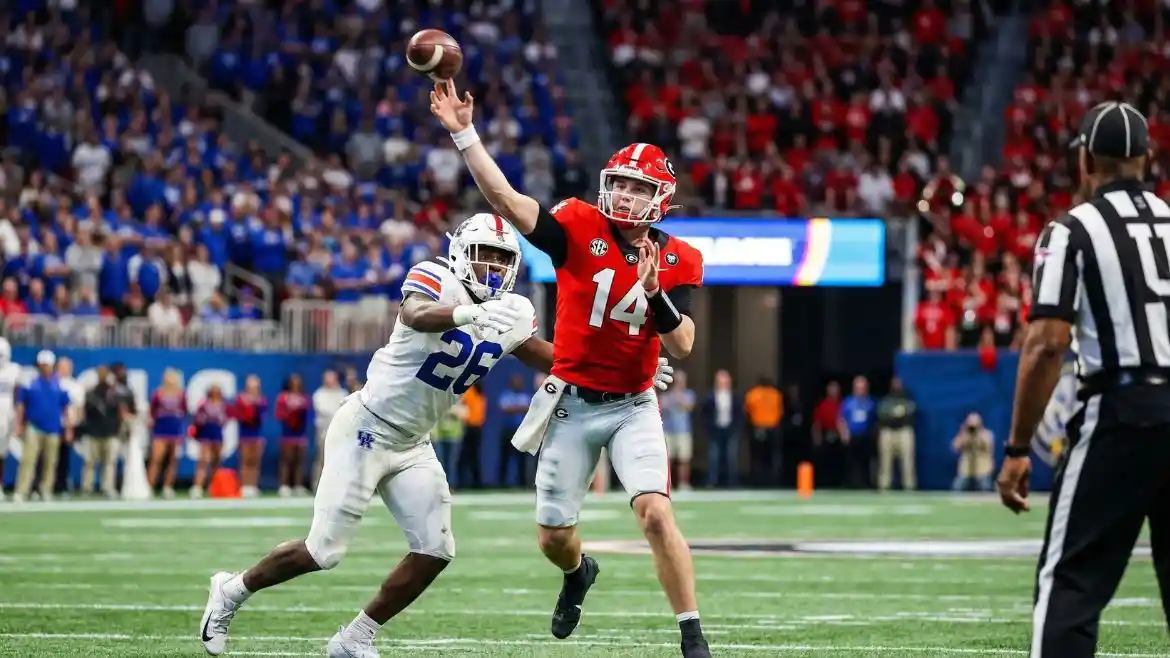
To understand the challenge Ole Miss football faced, one must look at the opposition’s leader. Georgia was piloted by Gunner Stockton (Georgia QB), a player who has waited his turn and developed into a formidable passer. Stockton’s ability to manage the game and make accurate throws into tight windows kept the Ole Miss secondary under constant stress.
Stockton directed two key touchdown drives in the first half, showcasing poise in the pocket. For the Ole Miss football defense, containing Stockton meant collapsing the pocket and forcing him to move off his spot. However, Stockton proved elusive, often finding his check-down receivers or scrambling for positive yardage when the play broke down.
The battle between the Ole Miss defensive front and Georgia’s offensive line, led by Stockton’s cadence, was the defining conflict of the game. It highlighted the level of competition that Ole Miss football must consistently overcome to hoist a national trophy.
The Enduring Culture of the Rebels
Regardless of the scoreboard in any single game, the brand of Ole Miss football remains one of the strongest in the nation. The program is built on tradition. It is about the “Hotty Toddy” chant echoing through the stadium. It is about the generational loyalty of families who have supported the team through thin and thick.
The 2026 season added another chapter to this rich history. Reaching the Quarterfinals proves that the program is not a flash in the pan; it is a consistent contender. The recruitment strategy, focused on speed and SEC readiness, has paid dividends.
Furthermore, the integration of the transfer portal and high school recruiting has allowed Ole Miss football to reload rather than rebuild. The coaching staff has done an excellent job of identifying talent that fits their specific systems. This adaptability is what keeps the Rebels relevant in the ever-changing landscape of college athletics.
Looking Toward the Future
As the dust settles on the 2026 season, the future of Ole Miss football looks bright. The experience gained by young players in high-pressure environments like the Sugar Bowl is invaluable. Playing against the best teams in the country exposes weaknesses that can be addressed in the offseason.
The goal remains the same: a National Championship. With the expanded playoff format, Ole Miss football has a clearer path to the title than ever before. They have proven they can navigate the regular season and earn a seat at the table. The next step in the evolution of the program is winning these heavyweight bouts against dynastic programs like Georgia.
Recruiting classes continue to rank highly, and the facilities in Oxford are second to none. The administration has shown a full commitment to providing the resources necessary for success. For the fans, the expectation has shifted from simply making a bowl game to competing for the biggest prize in the sport.
Conclusion
The 2026 campaign for Ole Miss football will be remembered as a successful stride forward. Reaching the College Football Playoff Quarterfinal is an achievement that places the Rebels in the upper echelon of the sport. While the Sugar Bowl 2026 presented significant challenges, including a tough halftime deficit against a powerful Georgia squad, the fighting spirit of the team was evident.
From the leadership of Trinidad Chambliss to the strategic adjustments of Head Coach Pete Golding, the pieces are in place for sustained success. The heartbreaking moments, like the Daylen Everette fumble return, serve as learning experiences that will harden the team for future battles. As we look ahead to 2027, one thing is certain: Ole Miss football is not going anywhere. The Rebels are here to stay, and the Grove will be ready to party again next fall. Hotty Toddy!
Frequently Asked Questions (FAQs)
Q: Who is the head coach of Ole Miss football in 2026? A: Pete Golding (Ole Miss Head Coach) is leading the team, bringing a defensive-minded approach to the program.
Q: Who is the starting quarterback for Ole Miss in the 2026 season? A: The offense is led by Trinidad Chambliss (Ole Miss QB), a dynamic playmaker who guided the team to the playoffs.
Q: What bowl game did Ole Miss play in 2026? A: Ole Miss played in the Sugar Bowl 2026, which served as a College Football Playoff Quarterfinal matchup.
Q: Who did Ole Miss play in the 2026 Sugar Bowl? A: The matchup was Georgia vs Ole Miss, featuring two of the top teams from the SEC.
Q: Who is the quarterback for Georgia in 2026? A: Georgia’s offense was led by Gunner Stockton (Georgia QB) during the Sugar Bowl.
Q: How many teams make the College Football Playoff in 2026? A: The College Football Playoff features 12 teams, with the Sugar Bowl hosting one of the Quarterfinal games.
Visit Vic Waves for the latest trending USA news, updates, and insights you may have missed today, and more stories.