

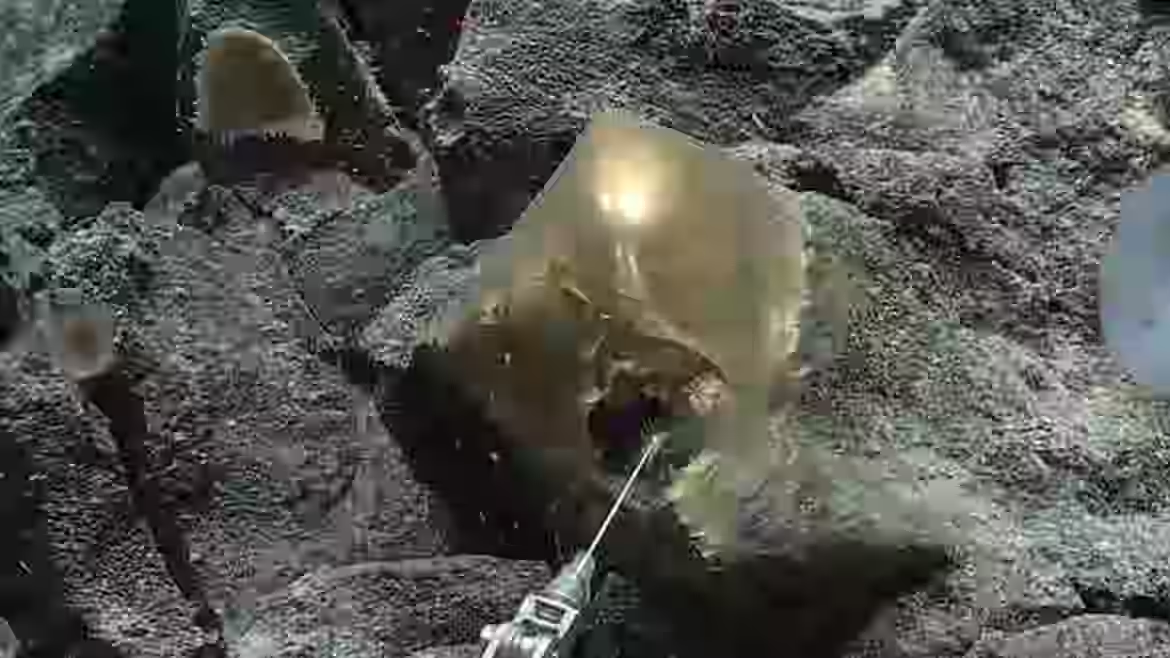
Golden orb Alaska mystery has finally been solved. NOAA scientists confirmed the strange object found deep in the Gulf of Alaska is not an alien egg, unknown creature, or mineral deposit. It is the leftover base of a giant deep-sea anemone, Relicanthus daphneae. The discovery gives researchers rare insight into deep-ocean life, biological decay, and how little we still know about the seafloor.
Table of Contents:
- NOAA Confirms the Golden Orb’s True Identity
- How Scientists Solved the Deep-Sea Puzzle
- Why Relicanthus Daphneae Matters
- From Alien Egg Rumors to Ocean Science
- What the Discovery Reveals About the Deep Ocean
- Golden Orb Alaska FAQ
Golden orb Alaska speculation began in 2023 when NOAA explorers spotted a strange golden object more than two miles beneath the Gulf of Alaska. The object was attached to a rock, had a small opening, and looked unlike anything the research team could immediately identify.
Now, after detailed analysis, NOAA says the mysterious golden orb was part of the base of a giant deep-sea anemone called Relicanthus daphneae. Specifically, it was the remnant of the structure that helped the animal anchor itself to the seafloor.
NOAA CONFIRMS THE GOLDEN ORB’S TRUE IDENTITY
The object was discovered during NOAA Ocean Exploration’s Seascape Alaska 5 expedition. A remotely operated vehicle found it at roughly 3,250 meters deep, where darkness, pressure, and cold make direct human exploration nearly impossible.
Scientists later determined the orb was made of dead cells and fibrous material from the anemone’s pedal disc. That is the part of the animal that attaches to hard surfaces, usually hidden beneath the living body.
HOW SCIENTISTS SOLVED THE DEEP-SEA PUZZLE
The first tests did not produce an easy answer. The object lacked obvious animal features, which made it difficult to classify through basic visual inspection.
Researchers used a mix of microscopic study, genetic work, and broader biological comparison. The presence of cnidarian traits, including specialized stinging-cell structures, helped point investigators toward corals and anemones.
WHY RELICANTHUS DAPHNEAE MATTERS
Relicanthus daphneae is a giant deep-sea anemone, not a small background organism. It can grow to impressive size, with a broad body and long tentacles suited for life in extreme ocean depths.
The golden orb gives scientists a rare look at what remains after part of such an animal is left behind. That matters because deep-sea life cycles are hard to observe, and even discarded tissue can teach researchers something useful.
FROM ALIEN EGG RUMORS TO OCEAN SCIENCE
The golden orb found in Alaska triggered wild theories almost immediately. Some viewers guessed it might be an alien egg, a new species, a sponge, or a strange deep-sea reproductive structure.
The real answer is less cinematic but more valuable. A known animal left behind an unusual biological trace, proving again that the deep ocean does not need fantasy to be strange.
WHAT THE DISCOVERY REVEALS ABOUT THE DEEP OCEAN
This case shows why deep-sea science moves slowly. One odd object required years of lab work, multiple experts, and advanced sequencing before researchers could confidently explain it.
It also shows how much remains undocumented. The ocean floor still holds biological evidence that scientists may only understand after careful collection, preservation, and cross-disciplinary study.
GOLDEN ORB ALASKA FAQ
What is the golden orb found in Alaska?
It is the leftover base of a giant deep-sea anemone called Relicanthus daphneae.
Where was the golden orb found?
It was found in the Gulf of Alaska, more than two miles below the ocean surface.
Was the golden orb a new species?
No. NOAA identified it as part of a known deep-sea anemone.
Why did it look so strange?
It was only the anemone’s leftover base, not the full living animal.
If you’re searching for Web Development, AI Automation, or AWS Cloud Architecture services, visit Shabihaz for expert solutions. Don’t forget to explore VicWaves for the latest trending USA news, updates, and important stories.